


Screw Press Separator for Slurry and Digestate | SEPCOM X
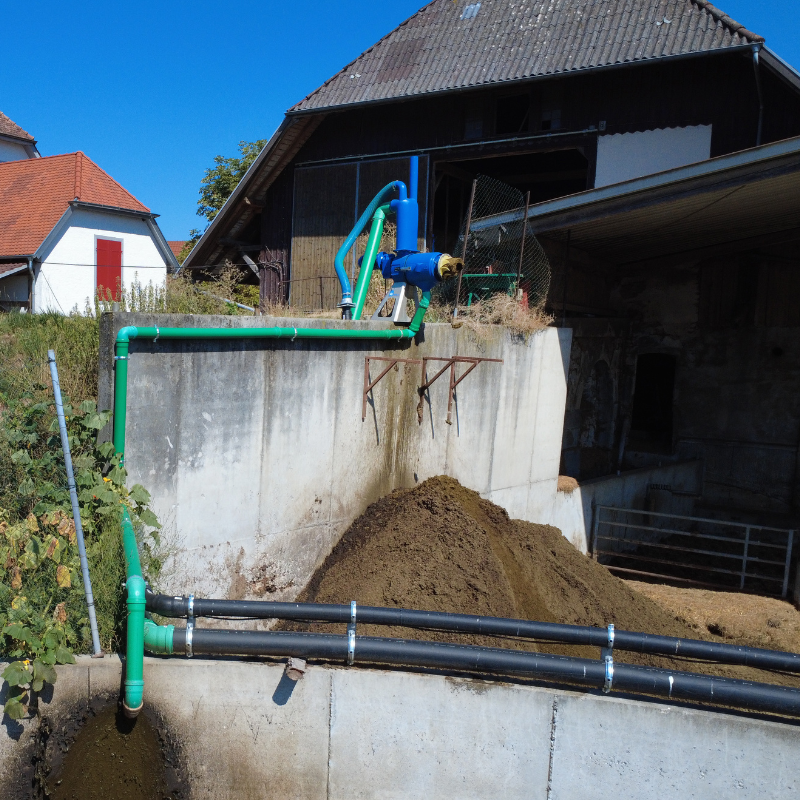
A screw press separator addresses a problem that affects both livestock farms and biogas plants: large volumes of pumpable material containing enough solids to complicate storage, transport and downstream treatment. Slurry, manure and digestate behave as single streams before separation, but the liquid and solid fractions within them often need very different handling. Dividing those fractions mechanically can simplify pumping, reduce the amount of free liquid carried with the solids and create more flexible options for subsequent use or treatment.
The value of separation is therefore not limited to reducing volume. A more stackable solid fraction can be moved and stored differently from the original slurry, while the liquid fraction can be pumped, stored or treated with equipment that would otherwise be affected by coarse suspended solids. In biogas plants, separation can also create a more controlled interface between digestion and digestate management.
SEPCOM X, developed by SAVECO, is a solids-liquid separator based on screw conveyor technology. According to the official brochure, it separates by gravity and mechanical compression and is designed for a wide range of materials, including sludge, sewage, manure, digestate, vegetable and fruit processing waste and other solid-liquid mixtures where the liquid content inside the solids can vary considerably.
How a screw press separator works
At the core of the machine is a rotating screw positioned inside a cylindrical wedge-wire screen. The feed material enters the separator and is moved forward by the screw. As it advances, free liquid drains through the screen under gravity. The remaining material is then progressively compressed, forcing additional liquid through the screen while the retained solids continue towards the outlet.
This combination of gravity and mechanical compression is what differentiates a screw press separator from a simple screen. Screening alone can remove free liquid from a coarse fibre structure, but compression increases the amount of liquid expelled from the solid fraction. The degree of separation depends on the physical characteristics of the material, the screen, the screw geometry and the resistance created at the discharge end.
The SEPCOM X outlet uses a diaphragm made from SINT engineering polymer. This component contributes to the controlled resistance required for compression. The solid fraction leaves through the discharge cone, while the separated liquid is collected outside the wedge-wire screen and directed away from the machine.
Why the characteristics of the feed material matter
Two slurries with the same total solids percentage can behave very differently inside a separator. Long fibres, fine suspended particles, dissolved solids, viscosity and free-water content all influence drainage. Cattle manure with a clear fibrous structure can form a compressible solid plug, while a much finer sludge may release water differently and require another operating balance.
The brochure explicitly states that SEPCOM X is intended for materials in which the liquid content within the solids may differ considerably. That versatility is important, but it does not remove the need for proper application evaluation. Feed properties influence throughput, dry matter in the solid fraction and the quality of the separated liquid.
For this reason, capacity should never be considered independently of the product. A separator may be mechanically capable of a high flow rate, but the practical operating point must preserve stable separation and avoid overloading the screen or discharge system.
Published performance of SEPCOM X
| Parameter | Published SEPCOM X information |
|---|---|
| Separation principle | Gravity plus mechanical compression |
| Maximum throughput | Up to 50 m³/h |
| Dry matter of separated solid | Up to 25% |
| Dry matter of separated liquid | Less than 5% |
| Available sizes | SEPX 125, 200, 250 and 300 |
| Screen diameters | 125, 200, 250 and 300 mm |
| Drive powers | 0.75, 2.20, 3.00 and 5.50 kW |
| Screw | 304L stainless steel |
| Wedge-wire screen | 304L stainless steel |
| Foot | 304L stainless steel |
| Feeding hopper and screen cover | Fully recyclable 04 LDPE |
| Loading module / discharge cone | Cast iron |
| Motor | IE3 Premium Efficiency electric motor |
| Accessory | Level switch |
The figures above describe the published range, not a guaranteed result for every slurry or digestate. The actual throughput and dry-matter values depend on the material, feed consistency, screen configuration, compression behaviour and installation conditions.
What does 'up to 25% dry matter' mean in practice?
The dry-matter content of the separated solid is one of the most relevant operational indicators because it describes how much free water remains with the solid fraction. A higher dry-matter value generally means a more compact and easier-to-handle material, although the physical feel of the product also depends on fibre structure.
SEPCOM X publishes output dry matter for the separated solid of up to 25%. This should be understood as a maximum performance figure for suitable applications, not as a universal result. A highly fibrous cattle slurry may respond differently from sewage sludge, digestate or vegetable-processing waste.
The liquid fraction is published at less than 5% dry matter. This does not mean that the liquid is free from suspended particles or dissolved nutrients. It means that the coarse solids load has been substantially reduced, creating a phase that is generally easier to pump and potentially easier to treat further.
Four sizes for different process requirements
SEPCOM X is available in four sizes: 125, 200, 250 and 300. The number corresponds to the screen diameter in millimetres. As the size increases, the machine dimensions, installed drive power and potential processing capacity also increase.
The smallest SEPX 125 uses a 0.75 kW drive, while the SEPX 300 uses 5.50 kW. Intermediate models provide 2.20 and 3.00 kW drive powers. This staged range gives plant designers a way to match the separator to different flow requirements without using an unnecessarily large machine.
Selection should consider not only the average hourly flow but also peak inflow, operating schedule and available buffer volume. A farm that separates for a limited number of hours per day may require a different size from a plant that operates continuously at a more stable flow.
Stable feeding is essential
A screw press separator works best when the feed reaches it consistently. Sudden surges can change the filling of the screw and the pressure developed in the compression zone. Insufficient feed can reduce the formation of the solid plug needed for stable operation.
In livestock applications, a collection pit or balancing tank may therefore be combined with agitation and pumping equipment. The purpose of agitation is to maintain a representative suspension without allowing heavy solids to settle. The pump should then provide the separator with a controlled flow compatible with the selected machine size.
A level switch is listed as an accessory for SEPCOM X. In a correctly designed line, level monitoring can support the coordination between the upstream feed system and the separator, helping prevent unsuitable operating conditions.
Easy access and quick assembly
Maintenance accessibility is one of the specific benefits highlighted in the SEPCOM X brochure. The machine is designed for easy access to its core and uses a quick assembly system. These features matter because the screw, screen and compression components are continuously exposed to abrasive or fibrous material.
Over time, the screen may need inspection or cleaning, and wear components may require attention. A separator that is difficult to open can turn routine maintenance into a long production interruption. Faster access reduces the practical cost of inspection and encourages preventive intervention before performance deteriorates.
The exploded technical view in the brochure also shows a relatively straightforward component architecture: motor, loading module, screw, wedge-wire screen, cover, discharge cone, diaphragm and support foot. This modular arrangement makes the functional areas clear and supports serviceability.
Recyclable components and material selection
SEPCOM X combines metallic structural and process components with recyclable polymer parts. The feeding hopper and screen cover are made from fully recyclable 04 LDPE, while the screw, wedge-wire screen and foot are 304L stainless steel.
The use of recyclable plastic parts is highlighted by SAVECO as a way to reduce environmental footprint. At the same time, stainless steel is used where the material is mechanically conveyed, screened and supported, providing corrosion resistance and durability in contact with wet process streams.
The discharge diaphragm uses SINT engineering polymer, while the loading module and discharge cone are cast iron. The material choices therefore reflect different mechanical functions rather than applying one material indiscriminately throughout the machine.
Applications in livestock farming
Livestock manure management is one of the primary applications shown in the brochure. Separating cattle slurry can create a solid fraction that is more practical to store and move with conventional farm equipment. The remaining liquid contains less coarse suspended material and can be handled separately.
The process can also provide greater flexibility in nutrient management because the two fractions have different physical characteristics. The separator does not remove all nutrients, and local agronomic rules still apply, but splitting the flow can make transport and storage strategies more targeted.
The actual result depends strongly on bedding material, dilution water, animal diet and collection method. These variables affect fibre structure and water release, so they should be considered when choosing the separator and operating conditions.
Applications in biogas and digestate treatment
Biogas is the second key application explicitly identified by SAVECO. After anaerobic digestion, digestate still contains water, suspended solids and nutrients. Mechanical separation can reduce the amount of solid material in the liquid fraction and create a separate solid stream for storage or further processing.
This may support downstream treatment because equipment such as microfilters, pumps or other nutrient-management systems can receive a more defined liquid phase. The solid fraction can follow a different route depending on the plant strategy.
Separation should be considered as part of the digestate-management line rather than as an isolated operation. Feedstock variability, digester operation, storage volume and final nutrient use all influence the required capacity and expected separation result.
Beyond manure and digestate
SEPCOM X is not limited to livestock and biogas. The brochure lists sludge, sewage, vegetable-processing waste, fruit-processing waste and other solid-liquid mixtures among the potential applications.
This broader use is made possible by the separation principle: if the material is pumpable, contains a separable solid structure and can form the necessary compression behaviour inside the screw press, mechanical dewatering may be possible.
Nevertheless, each new material should be evaluated individually. Waste streams from food processing, municipal applications and industrial processes can differ substantially in particle size, abrasiveness, fibrous content and chemical composition.
How to select a screw press separator
| Selection factor | Questions to answer | Why it matters |
|---|---|---|
| Material type | Manure, digestate, sludge, sewage or food-processing waste? | Defines separation behaviour |
| Total solids | Normal and maximum dry-matter content? | Influences throughput and compression |
| Fibre structure | Long fibres or predominantly fine particles? | Affects drainage and solid-plug formation |
| Required flow | Average and peak m³/h? | Determines separator size and operating hours |
| Target solid | How dry and stackable must it be? | Sets performance expectations |
| Liquid destination | Storage, pumping or further treatment? | Defines required liquid quality |
| Operating schedule | Continuous or batch operating windows? | Influences buffer and machine size |
| Maintenance access | Is there enough space around the separator? | Supports fast cleaning and servicing |
| Downstream handling | Where will the solid fraction discharge? | Avoids back pressure and operational blockage |
Maintenance priorities for long-term performance
Routine maintenance should focus on the screw, wedge-wire screen, discharge system, motor and seals. Changes in throughput or in the consistency of the separated solid can indicate screen fouling, wear or a change in feed characteristics.
Because the machine relies on drainage through the screen, keeping the screen open is particularly important. Accumulated fibres or deposits reduce the effective filtering area and may change the pressure profile inside the separator.
Operators should follow the official use and maintenance documentation and isolate the machine safely before opening it. The quick assembly and easy-access design can shorten intervention time, but it does not replace safe procedures.
Integrating SEPCOM X into a complete separation line
A complete installation may include a reception pit, agitator, pump, feed pipework, separator, liquid collection system and a dedicated area or conveyor for the solid fraction. The performance of the separator depends on how well these components work together.
Upstream equipment must supply a consistent feed. Downstream, the solid must leave freely and the liquid must be able to drain without creating back pressure. If further liquid refinement is required, a second treatment step can be added after the screw press.
SAVECO's wider portfolio includes equipment for pumping, agitation, separation and microfiltration, which makes it possible to design the separation stage as part of a coordinated process rather than as a standalone machine.
Technical FAQs about screw press separators
What is a screw press separator?
It is a continuous solids-liquid separator that uses a rotating screw, a screen, gravity drainage and mechanical compression to divide a pumpable mixture into solid and liquid fractions.
What materials can SEPCOM X process?
The brochure lists sludge, sewage, manure, digestate, vegetable and fruit-processing waste and other solid-liquid mixtures.
What is the maximum throughput?
SAVECO publishes throughput up to 50 m³/h for the SEPCOM X range.
How dry can the separated solid become?
The published figure is up to 25% dry matter for the separated solid, depending on the application.
What is the dry matter of the separated liquid?
The brochure states less than 5% dry matter for the separated liquid.
How many SEPCOM X sizes are available?
Four: SEPX 125, 200, 250 and 300, corresponding to screen diameters of 125 to 300 mm.
What material is the screw manufactured from?
The screw is 304L stainless steel, as are the wedge-wire screen and support foot.
Why is easy access important?
It reduces the time required to inspect and clean the screw, screen and other core components.
Can the separated liquid be treated further?
Yes. Depending on the required final quality, additional treatment such as microfiltration can follow primary separation.
A practical first step in solids-liquid management
A screw press separator is most effective when it is selected around the material and the downstream objective rather than capacity alone. SEPCOM X combines gravity separation and mechanical compression with four machine sizes, stainless-steel process components, recyclable polymer parts and an easy-access design. For livestock, biogas and compatible solid-liquid mixtures, it provides a practical way to turn one difficult stream into two fractions that can be handled more independently.
Explore SEPCOM X on the SAVECO website and contact us to define the most suitable screw press separator for your material, required throughput and downstream process.


